
How to replace an ironing board cover
Remove an old ironing board cover, check the padding, then fit and tension an elasticated or drawcord replacement without creases.
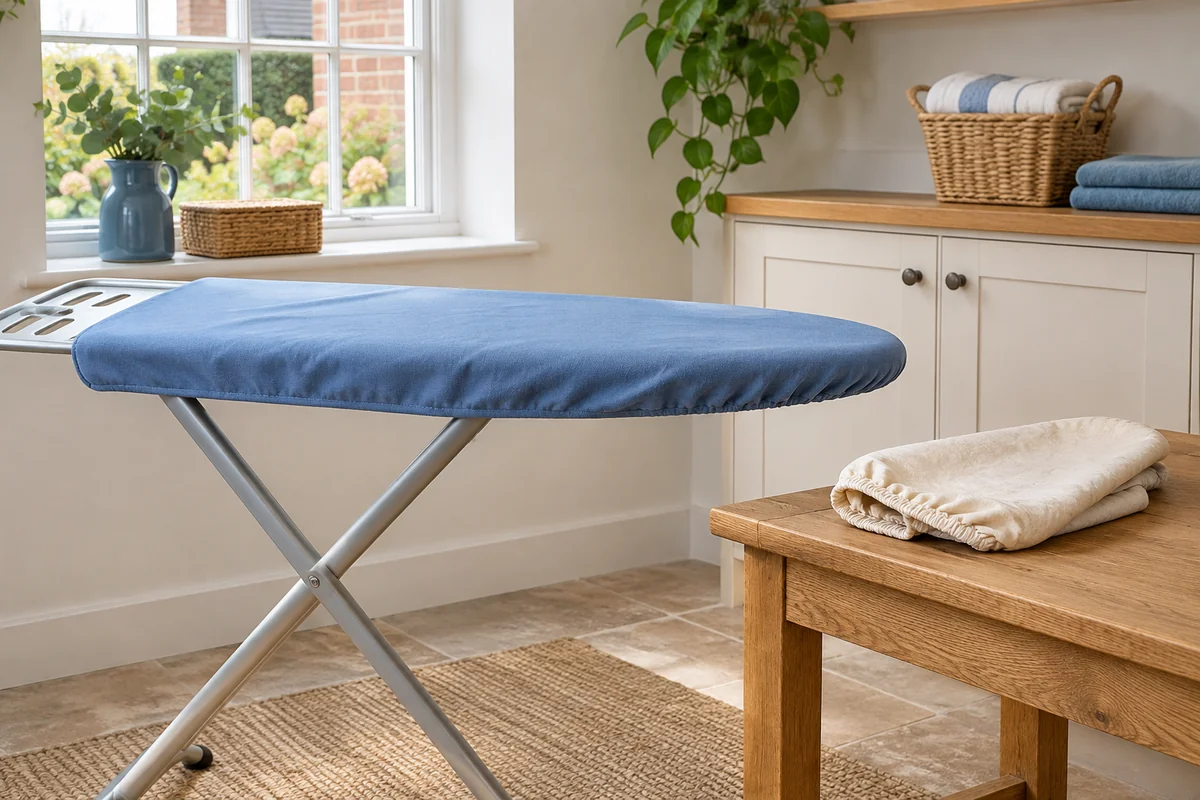
Work out what has worn out
An ironing board cover can shift because its tension has loosened or because the materials underneath no longer lie flat. Once the iron is safely out of the way, run your hand over the cool board. A surface that feels evenly supported but has a loose edge may need its fastening adjusted. Thin patches, a raised seam, a damaged drawcord or cloth that has worn through call for a closer check before ironing again.
If the fabric has started to transfer marks, look at the cover and the soleplate separately. An old scorch or worn patch in the cover is a reason to replace it. Residue on the iron can still mark fabric after you fit a clean cover. If you find it on the soleplate, use the appliance maker's cleaning instructions.
Step 1. Remove the old cover and identify the layers
Set the board up on a level surface and engage its working lock if fitted. Unplug the iron, let it cool and move it and any separate steam generator to a suitable safe surface. If the rest or cord guide gets in the way, follow the board instructions for access.
Release the drawcord, binder, straps or clips underneath. Ease the cover away from the rim and lift it off. If the old top has a separate pad, lift the pad carefully so you can see whether it is one piece and still sits flat. Some covers include their cushioning as part of the fabric or as part of a complete set. Check the original instructions if the layers are unfamiliar.
Take a photo of a legible size label and the fixing points. Dust or debris can make a new cover feel uneven, so clean the bare deck as its instructions allow and let it dry. Check the rim, deck and locking mechanism for damage before covering them again.
Step 2. Choose a top cover, an underlay or a complete set
If the top cloth is worn and the existing pad is in good condition, a compatible top cover can keep that pad in service. If the pad has compressed or split but the top still fits and is sound, replace the pad with one suitable for that setup. When both are worn, a compatible set replaces both layers together.
A cut-to-fit pad is useful when the maker allows separate padding. Brabantia's white 196423 felt underlay is sold as 135 × 49 cm and has 8 mm of padding. Check the deck shape before trimming. If the old pad still holds its proper outline, it may help you mark the replacement. If it has stretched or broken up, use the board outline and the pad instructions.
Brabantia Felt Ironing Board Underlay 196423
Brabantia lists an 8 mm polyester felt underlay that you cut to fit the deck. Use it with a compatible top cover and suitable board.
Good for
A worn separate pad beneath a sound top cover, where the board and cover instructions allow separate padding.
Bear in mind
This is the underlay. It needs a suitable top cover. Trim to the deck and check the fit before securing the cover.
- 8 mm felt
- Trim to fit
- Underlay only
Lay the new pad flat and check the ends and edges before fitting the cloth. A turned-under edge or doubled corner can create a ridge that the fabric follows. Where a complete cover already supplies its own padding, use the stated layer arrangement. Extra thickness can pull the cover away from the rim or interfere with the fit.
Step 3. Match the dimensions and the fastening
Measure from the nose to the back edge of the pressing deck and straight across its widest point. Use the cover maker's stated board fit and check the nose shape. The iron rest, side tray and cover fabric underneath the board are outside the measurement. For a fuller measuring walkthrough, see how to measure an ironing board.
Even if two covers list the same fit range, one may grip with elastic and another may need a drawcord and binder. Make sure the board has a rim the cover can hold and enough space to reach its fasteners. A folding tabletop board can need the exact cover that follows its hinge and attaches to its deck.
Step 4. Locate the first end, then tension the cover
Spread the padding flat and position the new cloth with the seams and shaped ends aligned to the deck. Fit the locating point identified by the maker. For a cover with elastic around the perimeter, settle the elastic below the rim and work around the edges a little at a time. For a drawcord, get the cloth centred and the edges evenly seated before tightening.
Vileda Total Reflect 163263 shows why the fitting order matters. On a suitable board 120–130 cm long and 38–45 cm wide, its elasticated section goes over the wide end. The cords are then adjusted around the rim and secured at the narrow end with the supplied clip. Follow the instructions for the cover and its separate foam layer.
Vileda Total Reflect Ironing Board Cover 163263
The cover includes a foil-backed cotton top and separate foam. An elasticated wide end locates the cover, and the cords secure at the narrow end with the supplied clip.
Good for
A suitable deck between 120 and 130 cm long and between 38 and 45 cm wide, with a rim and shape the fixing can grip.
Bear in mind
Check both dimensions and whether the deck allows the fixing to sit clear of moving parts. Vileda specifies wipe-clean care.
- 120–130 × 38–45 cm fit
- Clip and elastic fixing
- Foam layer supplied
Smooth the cloth from the middle towards the edges, working any excess out of the pressing area before securing the fastening. Check underneath for sections where the hem has slipped up or the pad has folded. If tightening makes a diagonal crease worse, loosen the fixing and centre the cover again. Pulling harder usually preserves the wrinkle if the fabric has caught underneath.
Find the cause if a ridge remains
Look at where the ridge begins. If it runs from a corner across the deck, the top may be pulled further underneath on one side. Release a little tension and centre the fabric before trying again. If the bump stays in the same place when the cover moves, lift the cover and check whether the underlay has folded or whether something is trapped beneath it.
If the nose pulls loose while the wide end stays secure, compare the cover's shape with the board. Check that the locating point is fully seated and that the rim grips all the way round. Use any straps supplied for that cover as directed, with room for the board's moving parts.
Step 5. Check the fit before applying heat
Move a dry cotton cloth gently across the cool board. The cover should stay put, with a smooth surface across the nose and main deck. If it shifts with the garment, look for an unsecured clip, slack cord or elastic sitting above the rim. Keep fastenings and loose cord away from the folding mechanism, feet and any iron rest.
Check the board closes and reopens correctly while the iron is away. If a fastening catches, reposition it as directed and check it again before use. Let the board cool and dry after steam ironing before folding it away. If you have a Brabantia 124 × 38 cm deck, the Board B cover guide explains which exact replacements supply padding and which reuse it.
For the folding tabletop range, use the Joseph Joseph Pocket cover fit guide. Check a wobbling frame before fitting any new cover.
Manufacturer fitting and care references
Frequently asked questions
Do I remove the old ironing board cover first?
Remove the worn top cover when fitting its replacement. Check the instructions to see which separate underlay, if any, stays on the deck. Remove worn padding if you are fitting a complete replacement set designed to replace it.
Can I keep the old padding?
Keep a separate pad if it is clean, dry, resilient and allowed with the new top layer. Replace padding that has become thin, uneven or damaged, and follow any model-specific layer instructions.
Which end should I put on first?
Check the fastening instructions. Vileda’s Total Reflect fits its elasticated section to the wide end first and secures the cords at the nose. Other covers use a shaped nose or another locating point first.
Why does my new cover slip or wrinkle?
Check that the cloth is centred, the padding is lying flat and the cord or elastic is seated beneath the rim. If it still shifts after adjustment, check the stated board fit and attachment type.
Can I machine wash an ironing board cover?
Follow the exact care label. Some covers can be washed and others are wipe clean. For example, Vileda specifies a damp cloth and rules out machine washing for its Total Reflect 163263.
Can I replace the cover on a folding tabletop board?
Use a replacement the manufacturer approves for the exact model. A centre hinge or a shaped fastening can affect fit, and the cover must clear the mechanism when the board folds.