
How much laundry should you put in a mesh wash bag?
Judge a laundry bag by the room around its contents, the zip and the wash programme. See when to split small items or choose a different shape.
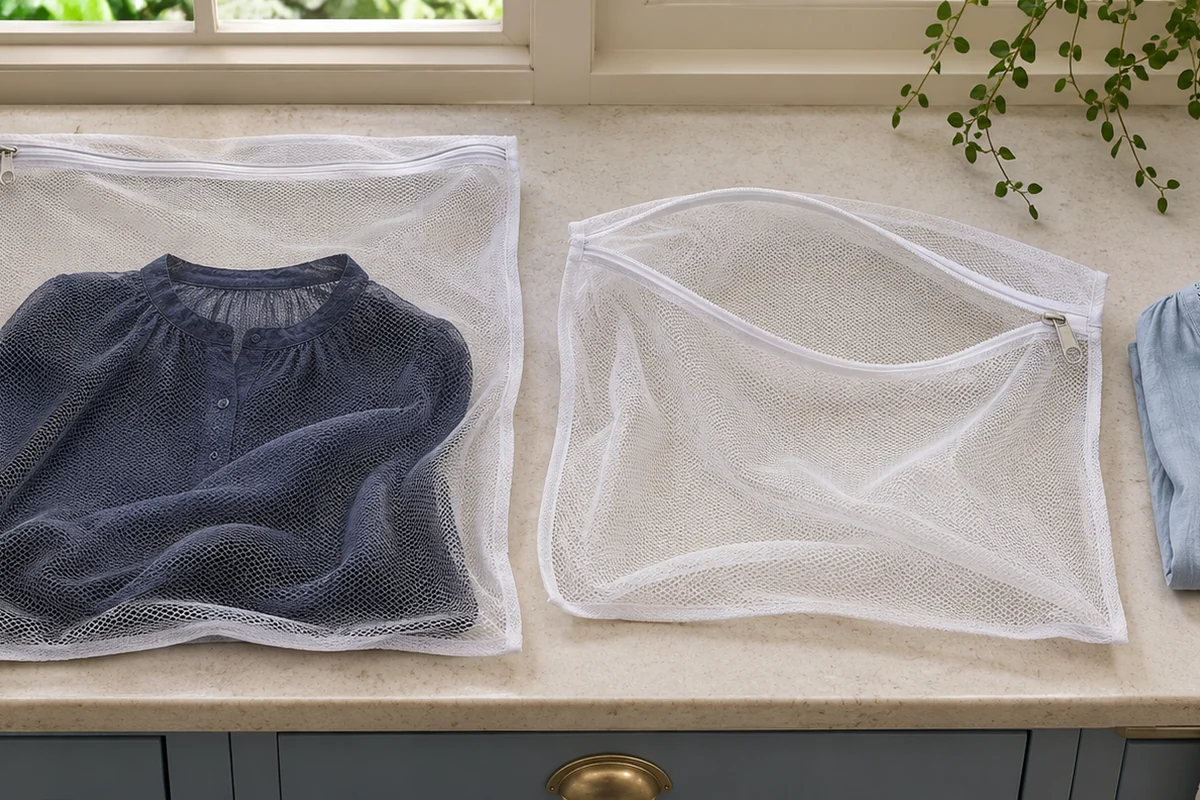
Leave room for the garment to move
A mesh wash bag should hold the intended garment without squeezing it into a compact bundle. The useful amount depends on the bag’s shape, its closure, the fabric and the garment’s construction. Read any capacity guidance from the bag maker first, then check the fit with the actual contents.
A bag that lies flat when empty becomes a different shape once filled. Thick cuffs, padding or a folded waistband take up depth as well as width. Place the garment loosely inside and close the zip without pressing down. If the closure is under strain, use another bag or a larger suitable size.
Keep the garment’s care label as the starting point. A bag helps contain compatible items during a permitted process. Temperature, programme, spin and drying instructions still come from the garment. The care symbols guide helps you check them before sorting.
Check three spaces in the wash setup
Scroll sideways to compare the bag, closure and drum checks.
| Where to check | A workable fit | Change the setup when |
|---|---|---|
| Inside the bag | The garment sits loosely in the intended shape | You have compressed, tightly rolled or sharply folded it |
| At the closure | The zip closes easily with fabric clear of its teeth | You must pull the sides together under pressure |
| Around the bag | The drum load suits the selected programme | Several full bags are packed between bulky laundry |
Match flat bag sizes to a real item
The Brabantia 149221 set contains two 33 × 25 cm bags and one 45 × 33 cm bag. That gives you a choice when one small item needs a separate bag and another takes up more of a panel. Lay out the garment beside each bag and check how much folding it needs to get through the opening.
Brabantia Wash Bags Set of 3 149221
Two smaller bags and one larger bag let you separate a few items without filling one net tightly. Each zip has a cover for the pull-tab.
Good for
Small garments or delicate pieces that fit loosely inside one of the two supplied sizes.
Bear in mind
These are flexible bags, so structured garments still need enough room to retain their shape. Follow the garment label and bag instructions together.
- Three bags
- Two sizes
- Covered zip pulls
Use a larger bag if a thin top fits the smaller one only when folded into a dense rectangle. If you put several small pieces together, spread them loosely and see whether they can shift instead of locking into one firm bundle. Match their colours and care requirements before grouping them. A pair of small bags can also keep hooks and trims apart more easily than one bag containing every delicate item.
The size printed on a bag helps you screen the options. It gives neither a guaranteed garment count nor a reason to fill the whole outline tightly. A short cotton sock, a padded bra and a fine scarf occupy space in different ways. Choose around the pieces you wash regularly.
Give cups, straps and trims their own room
A structured bra can reach the sides of a flat net long before it fills the nominal length. Look at the depth needed by the cups and at the ends of any wires. The bag should contain the bra without folding or flattening it to close. For softer underwear, keep straps out of the zip path and fasten hooks according to the garment instructions.
The Minky bra pair provides two separate cushioned mesh pouches, each approximately 17.5 × 25 cm. Use their size as a fit check for a bra that the label allows in a machine. The covered zip pulls help you keep the fastenings tucked away.
Minky Bra Wash Bags 2 Pack TT70491200
Two bra bags with cushioned mesh, protected zip closures and a colour-coded zip on each bag.
Good for
Machine-washable bras that fit the 17.5 × 25 cm bag loosely.
Bear in mind
Check fit around the cups and underwire ends. The flat measurements do not establish a universal bra size.
- Two bags
- 17.5 × 25 cm
- Covered zips
If the cups need a deeper shape, compare the flexible and reinforced options in the bra bag guide. Keep a bra that requires hand washing out of the machine load. A roomy bag cannot change the process its maker permits.
Separate unlike garments before counting pieces
Start by sorting for the allowed wash, then look at what may catch against what. A washable piece with decorative hardware can be awkward beside fine lace even when both fit one bag. Give the trim enough space to avoid pressing against another item, or follow the maker’s separate-wash instruction where supplied.
Do the same for colour. A mesh bag has openings for water and detergent to pass through, so colours still need to be compatible in the wash. Keep new or unstable colours separate as the garment instructions require. Treat the bag as part of load preparation, alongside selecting the correct programme and detergent.
For a small group of smooth compatible items, test the combined fit before closing. Put them in loosely and check for a hidden knot of straps or a waistband wrapped around another item. Split the group if you cannot rearrange it without squeezing everything back into the pouch.
Check the programme’s load limit as well
A drum’s headline capacity is usually a dry-weight figure for a stated programme. Follow the washing machine’s own instructions for the cycle you select. Delicate or wool programmes can have different load guidance from an ordinary cotton wash. The programme you are allowed to use affects the complete load, including all bags and loose items.
Leave the bags free to move as that programme requires. If a bag is wedged between large pieces when you load the drum, reduce the load or wash a suitable smaller group. Avoid deciding that another bag can fit merely because the door will close. For knitwear, read the mesh bag and knitwear guide before choosing the programme.
Recheck the contents when you unload
Open each bag and lift out the garments one at a time. If several pieces have wrapped tightly together, separate them gently and reassess the next load’s quantity and grouping. Check that every piece has rinsed and that no small item is left in a corner.
Let the empty bags dry with the zips open. Inspect the seams, mesh and covered pulls so they are ready for the next load. Keep a note of which garments fit each bag well if several people share the washing. A consistent pairing makes it easier to spot when an item needs a different size or shape.
Manufacturer specifications
Frequently asked questions
Should I fill a mesh laundry bag halfway?
Follow any limit given by the bag maker. There is no single fill fraction for every bag and garment. Check that the items sit loosely, can shift and do not put the closure under strain.
Can several pairs of socks go in one wash bag?
Group them only when their care requirements and colours are compatible and the bag remains loose. Split them if they form a tight bundle or put pressure on the zip.
Do the bag’s centimetre dimensions tell me its washing capacity?
They describe the bag’s size. The usable space depends on the shape and bulk of the garment, especially padding, cups, waistbands and trims.
Can I put several bags in one machine load?
Check the washing machine’s load guidance for the selected programme, including all bags and loose items. Leave the bags room to move instead of wedging them between bulky pieces.
What should I do if items come out twisted together?
Unpack gently and reassess how you grouped and filled the bags. Use separate bags or a suitable larger shape, and check the programme and care instructions before the next wash.