
Battery vs rechargeable fabric shaver
Compare replaceable AA and USB-C rechargeable bobble removers. Understand runtime claims, charging, cleaning and battery replacement before choosing a fabric shaver.
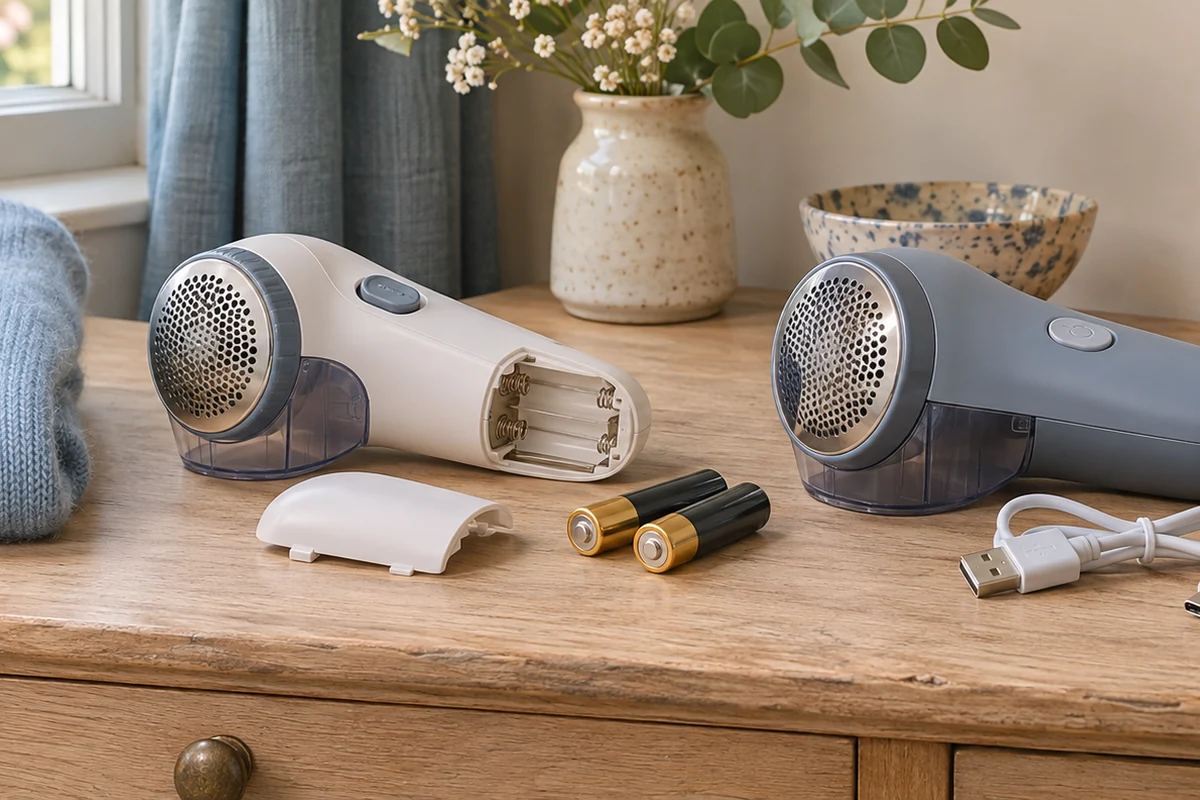
Start with what “battery” means on the listing
Both types use stored electrical energy. The useful shopping distinction is between a shaver with replaceable cells, such as AA batteries, and one with an internal rechargeable battery. “Cordless” can describe either. Look for the actual power specification and charging instructions before assuming that a cordless model comes with a USB cable or can take fresh batteries.
Choose replaceable cells if you prefer keeping the specified spares ready for occasional use. Choose a rechargeable model if you will remember to charge it and have a suitable place to do so. Then compare the parts that touch the garment. A convenient charging arrangement cannot compensate for a tool that the fabric maker advises against using.
Compare two exact examples
The Philips GC026/80 and Russell Hobbs Revive show the practical difference. The UK Russell Hobbs range calls the model 27660; the Amazon offer and manufacturer’s multilingual manual use the full reference 27660-56. These figures refer to those documented products, rather than every shaver sold under the brands.
On a phone, scroll sideways to read the exact power and maintenance differences.
| Specification | Philips GC026/80 | Russell Hobbs Revive 27660-56 |
|---|---|---|
| Power arrangement | Two replaceable AA batteries | Internal rechargeable battery; USB-C charging |
| Published runtime | Not specified in the linked Philips sheet | Up to 90 minutes, maker’s claim |
| Charging time | Not applicable to the supplied alkaline-cell arrangement | About three hours |
| Before opening to clean | Switch off and remove the AA batteries | Switch off and disconnect charging |
| Collection | Detachable pill container | Magnetically attached lint catcher |
| Storage detail | Keep the cap, guard and brush together | Travel lock; keep cable and brush available |
| Battery replacement | Replace the specified cells as instructed | Manual identifies battery as non-replaceable |
The runtime row has a deliberate gap. Philips does not supply a comparable figure in the cited sheet, so these examples cannot support a runtime winner. Likewise, a stated maximum is not a promise about the number of jumpers you will finish. Inspecting fabric, emptying the chamber and stopping around details are part of the task.
What replaceable AA batteries offer
A replaceable-cell shaver can suit someone who reaches for it only when a particular jumper needs attention. There is no charging appointment to remember; you need the correct batteries ready instead. Check the battery type as well as the size. The current Philips GC026 manual specifies AA alkaline cells, installed with the shown polarity.
The GC026/80 comes with two AA batteries, a height cap and a cleaning brush. Its power arrangement may appeal if you would rather replace a pair of specified cells than keep another cable in the drawer. Budget for future batteries and follow the instructions about removing them after use. Philips GC026/80 sheet · GC026 manual.
Philips Fabric Shaver GC026/80
The guarded shaving head removes attached pills into a detachable container. A height cap helps you adapt the head to the fabric, and two AA batteries are supplied.
Good for
Occasional de-bobbling on suitable garments laid flat, after a hidden-area check.
Bear in mind
Keep the blade away from seams, loose threads and open knits unless the instructions permit them. It cuts pills rather than lifting loose hair.
- Height cap
- Removable container
- 2 AA batteries
The compromise is managing that supply of cells. If the shaver is shared, keep its battery instructions with it so the next person knows what to fit. Avoid treating any AA-shaped battery as interchangeable. If you want to use a different chemistry, obtain confirmation for the exact appliance instead of inferring compatibility from a shopping description.
What an internal rechargeable battery changes
A rechargeable shaver removes the routine purchase of replacement cells. In exchange, it needs an appropriate charging connection and time before a depleted device is ready again. Keep the supplied cable accessible and read the indicator behaviour. A USB-C socket identifies a connection shape; the appliance instructions still determine how to charge it.
For the Revive 27660-56, the manual says to switch off before connecting to a powered USB port. The white indicator flashes during charging, stays lit when full, and the cable should then be disconnected. The UK maker advertises up to 90 minutes of shaving; the manual gives about three hours for charging. Russell Hobbs charging instructions · Revive manual.
Russell Hobbs Revive Fabric Shaver 27660-56
A USB-C rechargeable shaver with a travel lock and magnetic collection chamber. Russell Hobbs states up to 90 minutes of shaving and a three-hour charge.
Good for
Suitable flat textiles when a travel lock and pull-off magnetic chamber make storage and emptying more convenient.
Bear in mind
The maker cautions against angora and raised or textured knits. Check fabric suitability and keep clear of seams, pulls and trims.
- USB-C charging
- Travel lock
- Magnetic chamber
- Three-hour charge
The internal battery is described as non-replaceable. That matters when assessing long-term ownership, alongside the condition of the guard and cutter. Contact the maker if charging fails or capacity becomes inadequate. Instructions for dismantling at end of life should not be read as permission to fit an unapproved replacement battery and continue using the appliance.
Read runtime claims without inventing a garment count
A minute figure describes time, not area covered or pills removed. A small patch on one suitable cardigan and several affected panels on another garment can demand different preparation. Your stopping points also depend on seams, texture and whether the fabric remains safe to treat. Dividing a maximum runtime by a guessed “minutes per jumper” produces a number the maker has not established.
Use published runtime to decide whether a charging pause seems compatible with your routine. For a longer session, inspect and arrange each garment first, work only where permitted and allow time to empty the chamber. Keep the charge figure separate from claims about blade speed, head width or removal quality. Those measure different things and cannot fill a missing runtime specification.
Compare cleaning and fabric restrictions before power
A shaver that is easy to empty and inspect deserves attention whichever battery system you choose. Check how the guard attaches, whether the supplied brush reaches the identified parts and whether exact replacements are available. Follow the correct isolation procedure before opening it. Our guide to cleaning a fabric shaver covers these two models’ different arrangements.
Both still need a suitable garment. For example, the Revive instructions caution against angora and raised or textured knits, and direct users away from pulls and delicate areas. A charge indicator cannot tell you whether a raised loop is safe to cut. Check the garment advice and test an inconspicuous patch before doing visible sections.
Match the choice to your own routine
For a small household with an occasional bobbled cuff or side panel, ask which you already manage reliably: keeping specified cells or charging accessories. For several suitable garments, look beyond the runtime headline to collection capacity, handling and cleaning access. If different people share the tool, make its instructions easy to find rather than relying on memory.
If the tool will travel, consider how it stores, whether an accidental-start lock is provided and how its power source will be available. The Revive has a travel lock; follow its manual to activate or release it. For any model, protect the guard from damage in storage and inspect it before putting it back against clothing.
Finally, consider whether a powered cutter is needed at all. For a small area on knitwear whose maker permits combing, a manual tool may fit the job. Compare fabric shaver vs sweater comb or return to the fabric shaver buying guide once you know your preferred power arrangement.
Sources
Philips GC026/80 specifications · Philips GC026 manual · Russell Hobbs Revive UK product information · Russell Hobbs 27660-56 manual.
Frequently asked questions
Are rechargeable fabric shavers more powerful than AA models?
Rechargeability alone does not establish cutting performance. Compare the exact head, guard, intended fabrics and manufacturer information. There is no common performance test in the two examples here that supports a direct power ranking.
How long does the Philips GC026/80 run on its batteries?
The Philips specification sheet lists two AA batteries but does not publish a runtime. Do not substitute a runtime from another GC026 listing or assume how many garments a pair of cells will cover.
How long does the Russell Hobbs Revive take to charge?
The Revive 27660-56 manual states about three hours. It calls for the shaver to be switched off while charging and the cable disconnected when fully charged. Russell Hobbs advertises up to 90 minutes of shaving.
Can I use rechargeable AA cells in the Philips GC026?
The current GC026 manual specifies two AA alkaline batteries. Follow the instructions supplied with your exact appliance; do not assume that the AA shape alone approves a different battery chemistry. Never attempt to recharge non-rechargeable cells.
Can the battery in the Russell Hobbs Revive be replaced?
The 27660-56 manual identifies its battery as non-replaceable. Its end-of-life removal instructions concern disposal, not routine battery replacement or a user upgrade. Ask Russell Hobbs about support if the unit no longer holds charge.