
How to dry bedding on a clothes airer
Dry sheets, fitted sheets and duvet covers indoors by spreading the fabric, opening up folds and checking thick corners before storage.
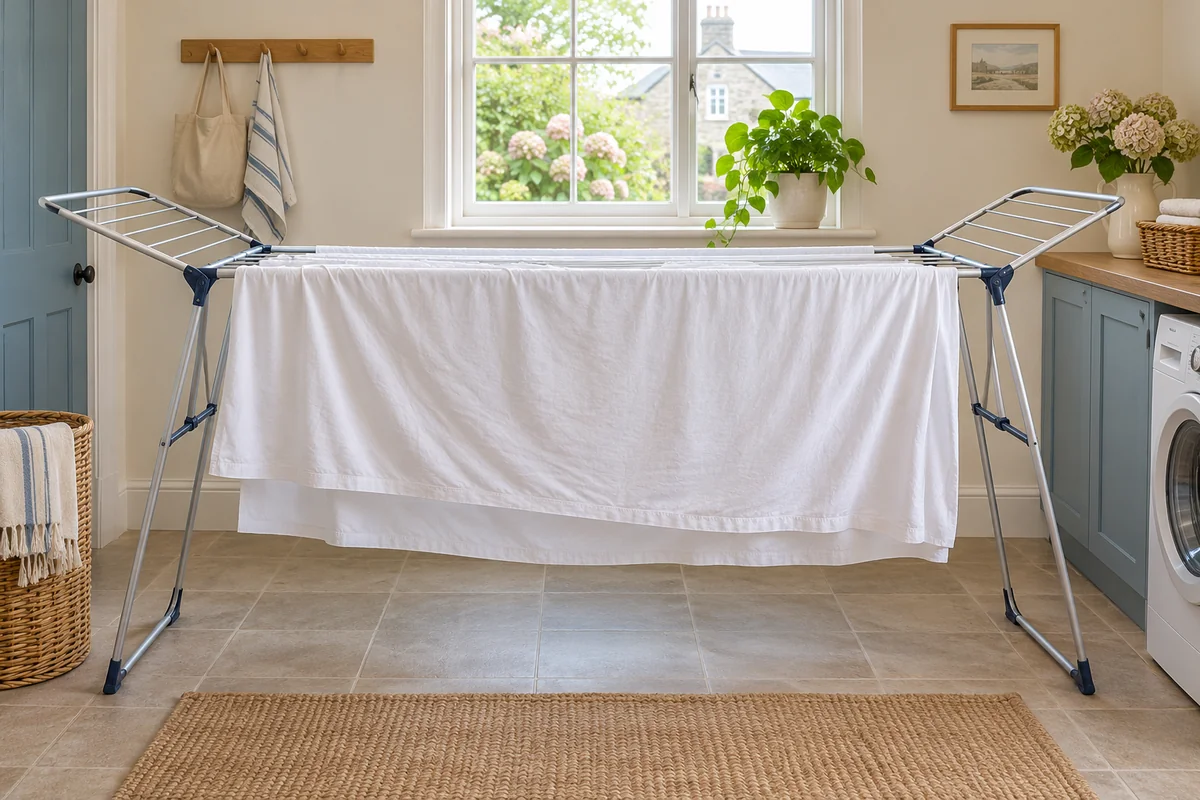
Give bedding its own space on the rack
A sheet can use more of an airer than a basket of shirts. It needs a long section without interruptions, enough height to keep both sides clear of the floor and space for the fabric to open up. Give the largest piece a position first. Put pillowcases or other small items elsewhere if they would otherwise sit under a hanging sheet and block airflow.
Follow the bedding's care label for washing, spinning and drying. Remove the pieces promptly after the cycle and shake them out while damp. Open up any twists before loading the airer. If sheets, pillowcases or other items have ended up inside the duvet cover, take them out and give them a separate place.
Check the span and the hanging drop
Measure the longest rail or central span that can support the sheet. The stated number of drying metres adds up many bars. It does not tell you whether a single sheet can lie across one useful span. Measure the drop from that bar to the floor or the shelf underneath it too. Take account of how the sheet will hang once its weight settles.
For example, Vileda's Infinity Flex 169959 extends its centre from 117 to 205 cm. It gives broad bedding a longer span than many fixed racks. The full frame with wings open is 216–304 cm long, so check the space available as well as the bedding width. You still need room to reach the fabric and pass the rack.
Vileda Infinity Flex Extendable Airer 169959
The centre rails extend from 117 cm to 205 cm, with raised side wings for longer garments. Vileda lists up to 30 m of drying line.
Good for
Bedding and broad items when you have a clear strip of floor for the open wings.
Bear in mind
The full frame is 216–304 cm long with the wings open. Check room for hanging laundry and access. The maker's product page gives no separate maximum wet-load figure.
- Up to 30 m drying line
- 117–205 cm central rack
- 8 cm folded depth
A short tower can work for pillowcases and smaller linen. For a larger sheet, use an open configuration the maker permits and leave rails below clear where the cloth needs to hang. If the sheet rests on the lower tiers in several layers, a longer winged frame or a separate drying session may make the job easier. Compare the two layouts in the tower and winged airer guide.
Spread a flat sheet with room between the faces
Hang the sheet in the broadest arrangement your rack and room allow. If you need to drape it over a bar, keep the hanging sides apart where the rack allows. On a suitable wide deck, you may be able to support the fabric across two spaced rails and leave an opening between the hanging sections. Distribute the damp weight within the rack's instructions and avoid letting the sheet trail onto the floor.
When the sheet is wider than the rails, fold only as much as necessary to make it fit. A loose fold that you can open and move later is more manageable than several tight folds. Reserve the adjoining rails so you can reach the fold without unloading the rest of the wash.
Open fitted corners and duvet cover closures
A fitted sheet often feels dry on the broad panel first. The elastic edges hold gathered fabric together, and a turned-in corner can hide a damp pocket. Open the corners before hanging it and check them again when the larger areas feel nearly dry. Shift the position so the elastic section gets air and the fabric is supported evenly.
A duvet cover has two layers even when it looks flat. Smooth out twisted fabric and keep the opening accessible. If the care instructions allow it, open the closure and reposition the cover during drying so you can check the inside. Pay particular attention to the corners and button or zip edge. Keep pillowcases separate so they do not nest inside and hold wet fabric together.
A filled duvet needs its own care instructions. Its damp weight and bulk can exceed what an ordinary airer can hold. Follow the maker's approved method and confirm the filling is dry before storing or putting it back on the bed. The steps for a removable cover apply to the linen around it.
Split a bedding wash when the largest pieces compete
If you have one long span and a small second rack, reserve the long span for the sheet or duvet cover and use the second for pillowcases. If two large pieces both need the same position, plan two wash-and-dry sessions so neither sits damp in a basket while it waits. This can be easier in a small room than trying to give two fully loaded frames enough floor space.
Check the room and turn the slow areas outwards
Use a stable rack in a room where ventilation can carry moisture away. Keep the loaded frame clear of walls, heaters, sockets and walkways. A large hanging sheet can change where air reaches the rest of the rack, so keep vents and any extractor clear. If you can dry outdoors, follow the bedding label and choose a suitable outdoor setup.
At your next check, feel the thick hems and folds. Rotate or shift the sheet when the inside is damper than the outside. Support the fabric while you move it so its weight stays balanced. With a crowded rack, move off dry pillowcases before spreading the sheet into the space they occupied.
Once the linen seems dry, check the last folded section, the fitted corners or the inside of the duvet cover. If they feel cool and you are unsure, open the piece and check for dampness again before folding. Leave bedding on the rack until all parts are dry. For heavy towel loads, use the towel drying guide. If the room regularly mists up, check ways to reduce condensation during indoor drying.
Sources and guidance
Frequently asked questions
How do I dry a king-size sheet on a small airer?
Dry it separately and use as few loose folds as the rack allows. Keep the sheet off the floor and rotate it so the inner fold gets exposed. If it can only fit in a tight bundle, use another drying arrangement permitted by the label.
Can I dry a duvet cover and sheet together on one airer?
Yes if there is a separate span for each, room around both and enough capacity for their damp weight. If one covers the other or blocks access to the inside of the duvet cover, dry them separately.
How do I stop a fitted sheet bunching up?
Shake it out, open the elastic corners and hang it across a wide supported section. Reposition it so the tucked fabric and elastic edges can dry.
Can a duvet itself go on a clothes airer?
Check the duvet’s care instructions and the airer’s load limits. The filling and its drying requirements differ from a removable cover. Use the duvet maker’s method and make sure the filling is completely dry.
How long does bedding take to dry on an airer?
It varies with fabric, spin, how many layers touch and room conditions. Check the slowest areas, including hems, closures, corners and folds, rather than relying on a fixed time.
Can I use a heated airer for a sheet?
Use it only when the bedding care label and the airer instructions allow that placement. Keep controls and required clearances free, and use an approved cover only as directed.