
Heated airer vs tumble dryer running costs
Calculate the heated airer vs tumble dryer electricity break-even time, compare costs using your tariff, and download your calculations. Includes custom cycle and label inputs.
Airer vs tumble dryer break-even calculator
Find when your airer reaches a dryer cycle’s electricity use, then compare the costs for your chosen runtime.
Use the worked comparison below or download the example calculations (CSV). Turn on JavaScript to enter your own figures.
Your comparison
- Same electricity use after
- Airer setup
- Dryer cycle
Cost crossover:
How the break-even figures work
Times in hours and minutes are approximate. All comparisons and downloadable figures use unrounded values. A weighted label figure describes reference conditions, so check the programme and load it represents.
How the airer estimate changes with time
Your airer power, rate and fixed additional kWh are used in every row. These runtimes are examples, not operating instructions.
Scroll sideways to compare the runtime examples.
| Airer runtime | Setup energy | Setup cost |
|---|
Includes your inputs, unit conversion, unrounded crossover times, costs, formulas and sources. Opens in Excel, Numbers or Google Sheets.
Break-even means equal electricity use or equal electricity cost. It does not predict drying time. Compare similar loads at the same starting moisture and final dryness. Costs exclude purchases and standing charges; follow each appliance’s operating instructions.
Starting rate: 26.32p/kWh, Ofgem’s Great Britain average for standard variable Direct Debit electricity, October–December 2026. Check the reference rate and enter your tariff. Sources checked November 2026.
Use and save your break-even calculation
Choose an airer wattage and enter the hours you want to compare. For the dryer, use the energy for the programme and load that match your washing. The examples here use the Beko BM3T3833W standard cotton programme: 1.08 kWh at partial load or 1.95 kWh at full load. You can also enter your own figure. If its unit is kWh per 100 cycles, select that unit and enter the full number shown; the calculator divides it by 100. A weighted reference cycle is not a guarantee for a particular load.
Energy crossover hours = (dryer kWh per cycle − additional airer setup kWh) ÷ (airer watts ÷ 1,000). For the default 230 W and 1.08 kWh, this is 1.08 ÷ 0.23 = approximately 4.695652 hours, displayed as about 4 hours 42 minutes. At four hours, the airer uses 0.92 kWh. At 26.32p/kWh that is £0.242144, compared with £0.284256 for the dryer figure: a difference of about 4.21p for these inputs.
The energy threshold stays the same when both methods use the same electricity rate. If they run at different unit prices, choose a separate dryer rate: the calculator then shows a distinct cost crossover. It handles zero rates without dividing by zero. If fixed extra electricity already exceeds the dryer figure, there is no positive energy crossover. Extra kWh are held constant while the airer runtime changes; update that input if another appliance’s use also changes.
Use Download my comparison to save your entered figures, the per-cycle conversion, unrounded crossover hours, costs, runtime table, formulas and sources as a CSV. Your inputs stay in your browser. The example calculation sheet also works without the interactive calculator. Times displayed in hours and minutes are approximate; the arithmetic and downloads retain unrounded hours. A crossover is a numerical threshold, rather than a recommended operating period or a prediction that the washing will be dry.
Put both methods in kilowatt-hours
A heated rail airer can have a low hourly cost and still run for much of the day. A tumble dryer can draw more power at a given moment and finish sooner. To compare electricity, ask how many kilowatt-hours (kWh) it takes to get a similar wash ready to put away. Then multiply the total by the unit rate on your bill.
Use watts ÷ 1,000 × hours to estimate the airer’s consumption if it draws its rated power continuously. For a tumble dryer, start with the cycle energy on its product sheet, if it gives a figure for the load and programme you want. A power rating on the back of the dryer alone cannot tell you how the heater, fan and drum behave through a cycle.
A 230 W heated rail airer example
Beldray rates the winged EH1156 at 230 W and lists a 15 kg load limit. That capacity describes the rack’s supported laundry load. It cannot be compared directly with the rated dry-cotton capacity of a tumble dryer. Rails and drying space can become the limiting factor before the wash reaches the airer’s maximum weight.
Beldray Winged Electric Heated Airer EH1156
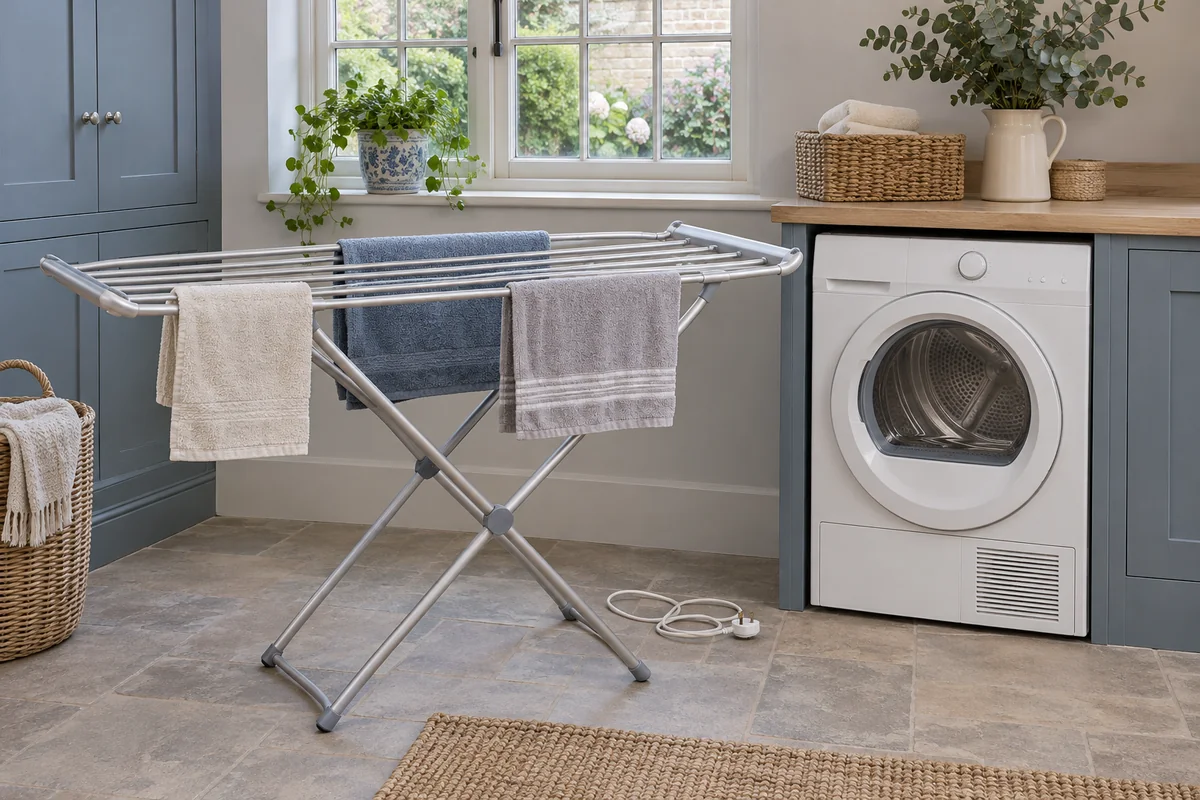
Eighteen heated bars sit across the main deck and wings. The airer is rated at 230 W and the frame collapses for storage.
Good for
A smaller regular load when there is room for a 148 cm-long winged rack.
Bear in mind
It has one heat setting and a 1.4 m cable. Check the socket position before choosing the drying spot.
- 230 W
- 12 m rails
- 15 kg maximum load
If this model drew 0.23 kW continuously, it would use 0.92 kWh in four hours or 1.38 kWh in six hours. These are run-time scenarios. A packed rack in a cool room may need a different session from a spaced load in a well-ventilated room. Keep to the appliance’s instructions and check thick seams, hems and pockets for dampness before calling the load dry. See how to load a heated airer and how to reduce condensation while drying indoors.
A heat pump tumble dryer example
The white Beko BM3T3833W is an 8 kg heat pump tumble dryer. Its product fiche gives 1.95 kWh at full load and 1.08 kWh at partial load on the standard cotton programme. The values are useful because they identify both the programme and the test load. A fast cycle, a different fabric programme or an extra-dry setting can use a different amount. Follow the labels on your clothes before choosing a cycle.
This exact model was unavailable when reviewed in November 2026.
Beko BM3T3833W heat pump tumble dryer BM3T3833W
Beko publishes 1.95 kWh at full load and 1.08 kWh at partial load on the standard cotton programme.
Good for
Suitable tumble-dry cotton loads where there is room for a freestanding machine and access to its filter and water tank.
Bear in mind
These are programme test figures. Other settings, starting moisture and fabric mixes change actual energy use.
- 8 kg rated cotton capacity
- Sensor drying
- 1.08 kWh partial cotton test
Read the unit beside the energy figure. If a newer label shows kWh per 100 cycles, divide by 100 to get the weighted reference amount per cycle. On a fiche that already gives kWh per cycle, use the number directly and look for the programme conditions. Older annual figures include assumptions about use and are less useful for a specific load. A dryer’s energy class also depends on the label scale. Compare the underlying figures and their conditions.
Compare the cost of the electricity
The table uses 26.32p per kWh, Ofgem’s October to December 2026 Great Britain average reference rate for standard variable Direct Debit electricity, checked in November 2026. Use your bill for your rate. For a time-of-use tariff, account for the hours when the electricity is used. The standing charge is separate from the extra cost of running a load.
Scroll sideways to see all the figures.
| Example | Energy | Cost at 26.32p/kWh |
|---|---|---|
| 230 W airer, four hours at rated draw | 0.92 kWh | 24.2p |
| 230 W airer, six hours at rated draw | 1.38 kWh | 36.3p |
| Beko standard cotton, partial test load | 1.08 kWh | 28.4p |
| Beko standard cotton, full test load | 1.95 kWh | 51.3p |
The airer would reach 1.08 kWh after about 4 hours 42 minutes at a constant 230 W. Below that threshold it uses less appliance electricity than the Beko partial-load test. Above it, it uses more. The threshold only compares electricity. To decide which is cheaper for your washing, check whether both methods reach the same dryness for comparable loads.
Make a comparison with your own laundry
- Start with similar items. Use the same mix of fabrics and a similar dry load weight. Run the same permitted wash and spin settings so the fabric starts with comparable moisture. Weigh the wet loads if that helps you spot a difference and you can do so safely.
- Agree the endpoint. If the load should be ready to put away, check its slowest-drying areas. An iron-dry setting intentionally leaves some moisture and is a different endpoint.
- Count the equipment you used. Record the airer’s active hours, or use measured kWh if the appliance instructions and measurement equipment allow it. For the dryer, use measured kWh or the closest documented programme figure. Include any extra run you need and any separate appliance used specifically for drying the load.
- Repeat on a typical day. Record room conditions, especially if they change noticeably. An open airer releases moisture into the room. A tumble dryer needs its specified installation and routine filter care. A single load on an unusually cold day can make one setup look very different.
If a load needs two airer sessions, add both. If you already use a rack and dehumidifier, see the heated airer vs dehumidifier guide for how to account for those two appliances. For a quick estimate before you can measure, use the heated airer running-cost guide.
Use the result to decide what to dry where
If you already own both, use the comparison on the types of wash you repeat. Shirts labelled for line drying may have an obvious place on a rack, while a compatible load of towels is worth comparing separately. If you are choosing what to buy, add the purchase cost, the space each appliance needs and how often you would use it. A difference of a few pence on one small load tells you little about whether an extra appliance earns its place in your home.
Sources and specifications
Frequently asked questions
Is a heated clothes airer cheaper than a tumble dryer?
It depends on how long the airer runs and how much energy the dryer uses on the chosen cycle. Compare total kWh to dry similar loads. A long airer session can use more electricity than a short, efficient dryer cycle.
How much does a 230 W heated airer cost for four hours?
At a constant 230 W it uses 0.92 kWh. At an illustrative 26.32p per kWh that costs about 24.2p. The actual draw can vary and four hours is an arithmetic example.
How do I use a tumble dryer label that shows kWh per 100 cycles?
Divide by 100 to get the label’s weighted energy figure per reference cycle. Look in the product information sheet for the stated programme and test loads before using it to compare with a specific wash.
Does the washing machine spin affect drying costs?
Yes. More water left in the fabric usually means more work to dry it. Follow each garment’s care instructions and use comparable spin settings and similar loads if you are checking two drying methods.
Should I count the dehumidifier if I use it alongside an airer?
Include its energy if you run it specifically for that load. Keep appliance electricity separate from room heating or ventilation costs that you cannot reliably assign to the drying session.
Can I compare my airer with a condenser dryer using this method?
Yes. Use the exact condenser dryer’s documented cycle energy or compatible measured consumption. The Beko example here is a heat pump model and its figures apply to its stated programme.