
Clothes steamer tank size, heat-up time and runtime explained
Read clothes steamer tank size and ready time, understand manufacturer runtime claims and decide how often you can expect to stop and refill.
What the three specifications tell you
Check the numbers in the order you will use the appliance. First you fill the tank. Then you switch on and wait for the ready indication. After that you use steam and refill when needed. Each number on the product sheet describes a different step.
Scroll sideways to compare the specifications.
| Specification | Common unit | What to check |
|---|---|---|
| Tank capacity | ml or L | The stated volume. Follow the tank marks and filling instructions. |
| Heat-up time | Seconds or minutes | How long the manufacturer says the appliance takes to reach its ready state. |
| Steam output | g/min | The stated rate in the mode described. Check whether it is continuous or a boost. |
| Runtime | Minutes | How long the maker says it will run under stated conditions, if it publishes a figure. |
A short ready time can be useful for last-minute work. A bigger tank can be useful when you have several garments already hanging. For both jobs, the number of minutes before you finish also includes arranging the garment and moving around it.
Tank capacity affects refills and handling
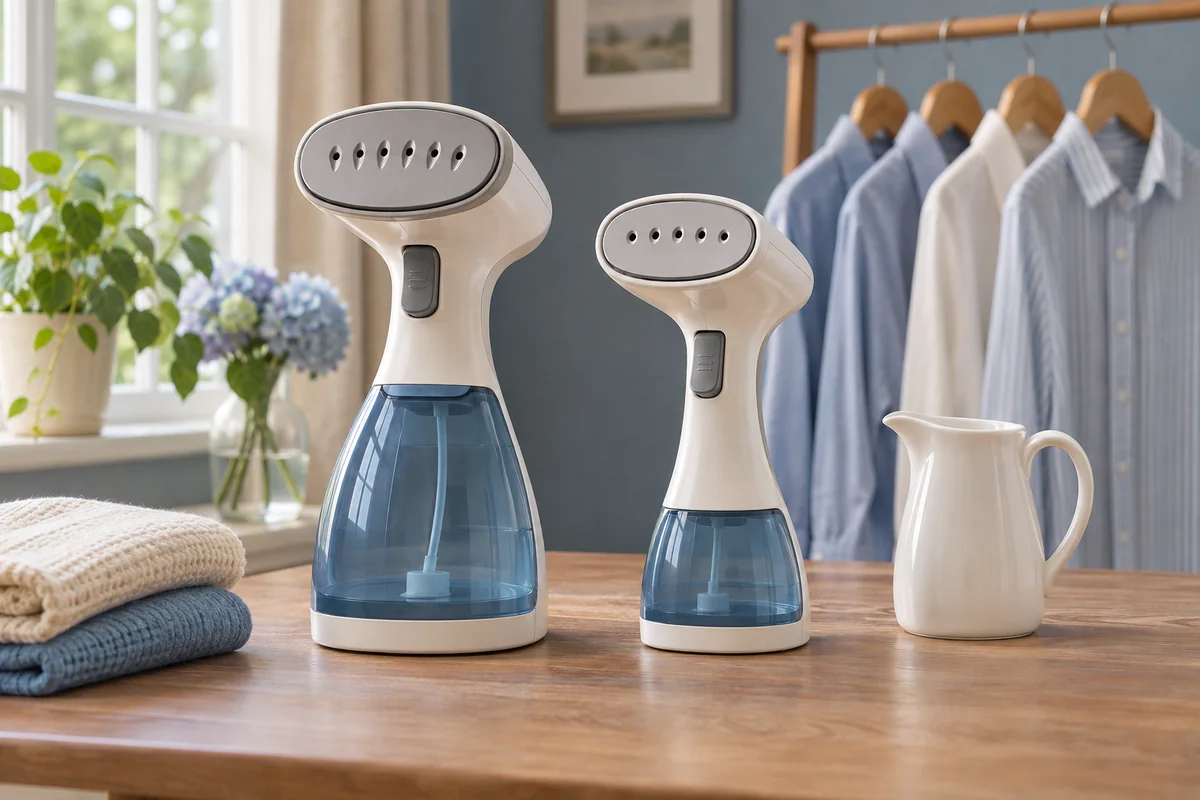
A litre holds 1,000 ml. A 1.3 L base therefore has much more room for water than a 70 ml handheld. With a handheld, that water is part of the load you lift. With an upright, the water stays in the base and you guide the head and hose. Also check how much room the removable tank needs to lift out, how it fits under your tap or jug and where you can put it during filling.
The Tefal Pure Pop DT2026G0 shows why quick heat-up and a small tank can go together. Tefal quotes a 70 ml removable tank, a 15-second heat-up and up to 20 g/min steam output. It suits a short touch-up, especially if you can fill and set it up close to where you dress. Those three figures do not establish a runtime for the model.
Tefal Pure Pop DT2026G0
A slim handheld with a reversible pad and a 70 ml removable tank. Tefal states a 15-second heat-up and up to 20 g/min of steam.
Good for
Short touch-ups on suitable hanging garments, especially if the reversible pad is useful to your routine.
Bear in mind
The small tank calls for more refills on longer jobs. It does not fold. Follow the supplied instructions for permitted positions.
- 70 ml tank
- Reversible pad
- 15-second heat-up
- 2 m cord
Follow the fill mark and instructions for the exact model. For an integrated tank, you may need to position the steamer in a particular way while filling. For a removable tank, check that the cap and tank are properly seated before starting. Water for steam irons and clothes steamers.
Heat-up time ends at the ready indication
A manufacturer’s heat-up figure usually describes how quickly the appliance reaches its operating state from a start. Use the model’s signal, such as a light that changes or stops flashing. If the instructions call for priming the pump on first use or after a refill, allow time for that separately.
When comparing two models for a morning routine, think about what happens before and after the signal. One may already be next to a suitable hanging point. The other may need a pole extending and a panel fitting. For a row of garments, those setup steps may be worthwhile. For a single shirt, they may make more difference to your total time than a small change in the quoted heat-up.
Read a published runtime in context
The Russell Hobbs Steam Genie Essential 25591 has a 200 ml removable tank and a 45-second stated heat-up. Russell Hobbs quotes up to ten minutes of steam time for this exact model. That is a published runtime claim for the 25591. The Pure Pop’s shorter heat-up gives you a quicker start, while the Essential carries more water. Use the runtime where the maker supplies it.
Russell Hobbs Steam Genie Essential 25591
Russell Hobbs quotes up to ten minutes of steam and a 45-second heat-up. The 200 ml removable tank sits in the handpiece.
Good for
A handheld setup with more water on board than a small travel format.
Bear in mind
A filled tank adds weight to the handpiece. Unplug before filling as the manual directs.
- 200 ml tank
- 45-second stated heat-up
- Up to 10 minutes stated
- Steam trigger lock
Separate steam-on time from the elapsed time for the session. If you pause between passes or set the head down to swap a garment, a trigger-operated model can use steam differently from one that continues emitting steam in its current setting. The manual tells you whether the machine has a trigger, lock or continuous mode and how to pause safely.
Keep arithmetic estimates separate from runtime claims
Suppose a hypothetical steamer could use every gram of a 100 ml fill and maintain a constant 20 g/min. At about one gram per millilitre, that would give a simple estimate of about five minutes. It assumes the entire fill is usable and a constant rate throughout. Use that calculation to understand the units. For a real model, look for a published runtime and its conditions or observe an ordinary session with your appliance.
If a listing gives a large output figure, check whether it refers to continuous steam or a brief boost. A boost cannot stand in for a constant rate in the calculation. Even two continuous figures can be quoted in different modes or test conditions. Steam boost, continuous steam and pressure explained.
Choose the number that solves your problem
For one outfit, look at the ready signal, reach and how easily you can store the cooled unit. For repeated garments, check the tank’s usable fill, how to refill and whether the head and hose can move comfortably. If you currently stop mainly to move garments, a better hanger setup may save more effort than a bigger tank. Handheld vs upright clothes steamers.
If you already own a steamer, note what happens on your next normal session. Start with the fill and setting you normally use. Record which garment you reach before you need to stop for water, and whether the stop happens before or after you have moved the garment. That tells you more about your routine than trying to keep the trigger held until the tank empties. Follow the usual instructions for refilling and switching off.
Manufacturer specifications and instructions
Frequently asked questions
How long will a 100 ml clothes steamer last?
Look for the exact model’s stated running time and the conditions it applies to. Capacity alone cannot tell you how long it steams. Steam setting, trigger use and usable water volume affect the answer.
Does a 15-second heat-up mean I can finish a shirt in 15 seconds?
The figure describes when the steamer is ready to start. Allow additional time to hang the shirt, pass over the fabric and let any moisture disperse before wearing it.
Does a bigger steamer tank always last longer?
A larger tank holds more water. Runtime also depends on the steam setting and how the appliance uses that water. Compare manufacturer runtime figures only when their conditions are comparable.
Can I work out runtime from tank size and grams per minute?
The calculation can illustrate how long a volume might last at a hypothetical constant rate. It does not establish an appliance’s actual runtime. Use an exact manufacturer runtime figure or measure the appliance under your own ordinary use.
Can I refill my steamer while it is hot?
Follow the exact model’s procedure. A removable tank describes how it comes off. Check whether the manual requires switching off, unplugging or waiting before you remove and refill it.