
Heated airer vs dehumidifier for drying washing
Compare separate airer and dehumidifier runtimes, optional combined-appliance electricity, room needs and downloadable calculations.
Airer vs dehumidifier cost calculator
Give each setup its own runtime. Compare the electricity for a heated airer alone with a dehumidifier and an unheated rack, or add a heated airer to the second setup.
Use the comparison and method below. Turn on JavaScript to use the interactive tool. Download the example calculations (CSV).
Your two electricity scenarios
See the calculation
For each appliance: kWh = watts ÷ 1,000 × hours. Cost in pounds = kWh × rate in pence ÷ 100. If you add a heated airer, its energy is added to the dehumidifier scenario. Arithmetic uses unrounded values; displayed pounds are rounded to pennies.
Includes entered figures, formulas, unrounded results and source references.
Assumes constant draw at the entered watts, excluding the standing charge. This compares electricity scenarios, not drying speed or equivalent finished loads. Runtimes are inputs, not recommendations. Follow the appliance instructions.
Starting tariff: 26.32p/kWh for October–December 2026, Ofgem’s Great Britain average for standard variable Direct Debit electricity. Tariff source. Meaco power and operating-condition source. Use your own figures.
Source references checked November 2026. Published measurements and specifications are separate from the calculations.
Compare separate runtimes, not just watts
A lower wattage can use more electricity if it runs for longer. Enter the hours for each setup separately. With the starting examples, a 300 W airer for 4 hours uses 1.2 kWh. A dehumidifier drawing 151 W for 8 hours uses 1.208 kWh. At 26.32p/kWh the costs are 31.584p and 31.79456p: both round to £0.32, while the unrounded difference is 0.21056p. These are arithmetic scenarios, not a finding that either appliance dries a load in those hours.
The 151 W preset belongs to the MeacoDry Arete One 12L at 20°C and 60% relative humidity. Its published draw changes with operating conditions, and compressor cycling can change the average draw across a session. A whole-session energy reading in kWh is more representative of that session than assuming a constant rating. To model such a reading here, calculate average watts as measured kWh × 1,000 ÷ active hours, then enter those hours and watts. A previous session remains an observation of that particular load and room, not a forecast for the next one.
Account for both appliances in a combined setup
If you plan to use a heated airer alongside the dehumidifier, enable the extra appliance fields. Enter each appliance’s own runtime; they do not have to run for the same length of time. The second scenario adds both energy figures and applies its entered electricity rate. Check the manuals for positioning and operation before combining equipment. An unheated rack adds no appliance electricity in this calculation.
If your two scenarios use different tariffs, enable the separate rate. Each entered rate applies throughout that scenario; for a time-varying tariff, use an appropriate energy-weighted rate or calculate the separate periods yourself. Electricity costs exclude the standing charge. Save your entries with Download my calculations, or use the worked example calculation sheet (CSV) without the interactive tool.
Decide what needs to change about your drying setup
A heated airer puts warmth into the wet washing where it rests on the bars. A dehumidifier pulls room air through the appliance and collects some of its water. The clothes still need somewhere to hang. In both cases the gaps around the clothes, the amount of water left after spinning and the temperature of the room affect the session.
Start with what you observe during a normal load. If some garments dry while thick seams stay damp, better spacing and a rail arrangement that suits those garments may help. If the air and windows get noticeably damp during repeated indoor loads, make a plan for getting the moisture out. Existing home ventilation remains part of that plan. When you can use outdoor drying, you avoid releasing the wash water into the room.
Scroll sideways to compare what each appliance does.
| Decision | Heated rail airer | Dehumidifier and separate rack |
|---|---|---|
| Main job | Warms fabric on the rails | Collects water from the air |
| Space needed | Open frame, safe cable route and room to reach the load | Rack plus a clear, suitable floor position for the appliance |
| Day-to-day job | Load the rails within their limits and follow operating instructions | Space the washing, empty the tank or set up permitted drainage and look after the filter |
| Useful comparison | Measured energy until the load is dry | Measured energy to similar dryness, with water collected as a separate observation |
A heated airer for warming the load directly
The Dry:Soon Standard three-tier airer has a 300 W rating, 21 m of drying line and a stated 15 kg wet load limit. It fits a routine where you can spread compatible garments on rails and leave the frame open in a suitable ventilated position. The folded frame is shallow, but that measurement has little bearing on whether a loaded rack fits in the room.
Dry:Soon Standard 3-Tier Heated Airer 53179
Lakeland lists a 300 W rating, 21 m of drying line and a 15 kg wet-load limit for the standard three-tier format. The shelves fold for storage.
Good for
A mixed wash when the full rack fits and you can reach all the tiers.
Bear in mind
This link is for the standalone standard airer. Check cover compatibility and which accessories come with the chosen listing. Running cost depends on power drawn, runtime and tariff.
- 300 W
- 21 m drying line
- 15 kg wet-load limit
Plan what happens to the moisture as the clothes dry. Check that any cover is suitable for the exact model and use it as instructed. A fitted cover can change airflow near the clothes, so follow the instructions about clearances, loading and supervision. For dry-flat garments, make sure the rails or a permitted support keep the fabric in shape. Follow the garment label before applying heat.
A dehumidifier for collecting water from the air
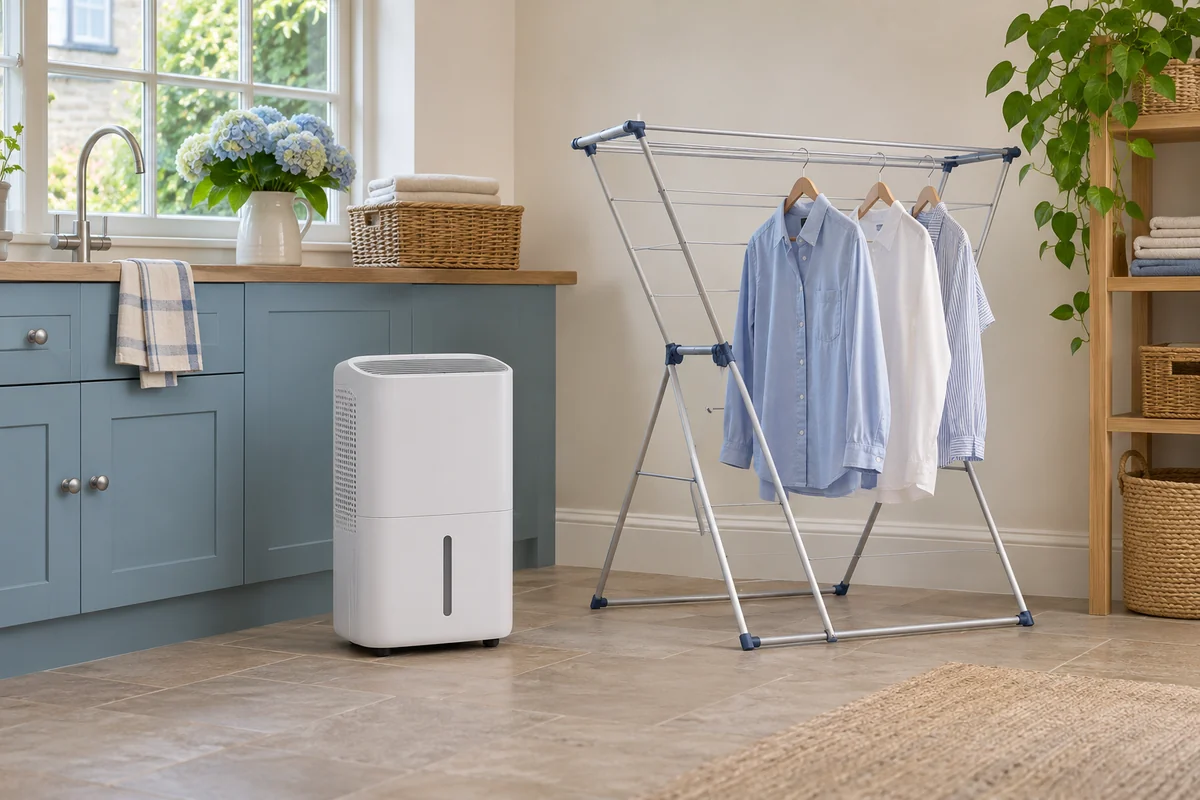
Meaco lists 151 W and 5.23 litres per day at 20°C and 60% relative humidity for the Arete One 12L. Meaco gives the nominal 12 L daily extraction at 30°C and 80% relative humidity. The actual amount collected depends on temperature, humidity, airflow and how long the compressor runs. The unit has a separate 2.5 L tank and a laundry mode. Those are useful features to compare if you already own a rack you can use.
MeacoDry Arete One 12L Dehumidifier Arete One 12L
This compressor model has a 2.5 L tank and a laundry mode. Meaco lists 5.23 L per day extraction and 151 W draw at 20°C and 60% relative humidity.
Good for
An unheated rack and a suitable indoor room where collecting airborne moisture is a priority.
Bear in mind
The 12 L class refers to extraction in warmer, more humid test conditions. It needs a separate rack, suitable placement and regular tank or drainage checks.
- 2.5 L tank
- Laundry mode
- 151 W at 20°C / 60% RH
Give the unit the clearance and position specified in the manual and keep it clear of drips. Make a place for the tank to come out without moving the wet clothes. If you use continuous drainage, follow the manual for the hose and where the water can drain. You still need enough floor space for the loaded rack, so measure the whole arrangement before buying an extra appliance.
Laundry mode is a control setting with a timed routine. The end of that routine is a good time to check the load, with thick seams and towel hems the last places you should check before putting everything away. Water in the tank can also have come from the surrounding air and other sources in the room.
Compare electricity at the same duration and at the same dryness
At 26.32p per kWh, four hours at a constant 300 W uses 1.20 kWh and costs 31.6p. Four hours at a constant 151 W uses 0.604 kWh and costs 15.9p. The second example holds the Meaco's documented draw at 20°C and 60% relative humidity constant for the arithmetic. A real compressor can cycle, and draw changes with conditions. The tariff is Ofgem’s October to December 2026 reference average for Great Britain standard variable Direct Debit customers, checked in November 2026. Rates vary by region, payment method and tariff. Use your own bill for an estimate at home.
The figures compare equal hours. To compare similar results, consider how long each appliance actually needs for the same type and starting moisture of load. For instance, eight hours at 151 W uses 1.208 kWh, close to the 1.20 kWh of the four-hour airer example. That illustrates how a longer session can close an apparent cost gap. Neither period predicts a drying time. The heated airer running cost guide shows how to work with actual kWh.
Compare a regular setup rather than one unusually damp day
For a practical comparison, make a note of the room conditions, the spin used, the amount of clothing on the rack and the time you check for dryness. Repeat with similar washing if you can. A dehumidifier can run less once the room reaches its target, while pockets or hems may still need time. Record whether the final condition actually suits putting the clothes away.
Consider the everyday work too. For the dehumidifier, check whether you can comfortably reach the tank and clean the filter. For the airer, allow a clear place for the open frame while it cools after use. These routine tasks help decide whether either arrangement is easy to use week after week.
Fit the method to your room
If you have a suitable well-ventilated room and the main constraint is a routine for several compatible garments, start by checking whether the heated rail layout solves it. If collecting airborne moisture is a priority and your existing airer gives the clothes room, a dehumidifier is more directly matched to that job. A cold room also warrants checking the dehumidifier's operating range and its documented extraction in conditions close to yours. The Arete One 12L's specified operating range is 5°C to 35°C, which describes where it can operate rather than a promise of equal performance across that range.
Follow the home ventilation guidance and keep any required ventilation working. A portable dehumidifier collects water from room air and supplies no fresh air. If damp or mould persists, look for the source and address it with the appropriate housing or repair contact. For an unheated rack to pair with a moisture-control routine, compare tower and winged airers.
Sources and specifications
Frequently asked questions
Which is cheaper to run, a heated airer or a dehumidifier?
It depends on the draw and runtime. At 26.32p per kWh, a 300 W rail airer costs 7.9p an hour at full draw. The 151 W Meaco example at its stated test conditions is about 4.0p an hour at that draw. Compare actual kWh until similar loads are dry.
Will a dehumidifier dry clothes without a heated airer?
Yes, a dehumidifier can assist clothes drying on an unheated rack. Leave room between garments and follow the dehumidifier’s positioning and operating instructions. Time varies with the room and the washing.
Does a heated airer remove moisture from the room?
Heated rails supply warmth. Water leaving the washing goes into the room air, so use the ventilation available in your home. A cover changes conditions around the clothes while the water still needs somewhere to go.
Can I run a dehumidifier and heated airer together?
Check both manuals, the room and the electrical setup before combining them. Keep the dehumidifier clear of drips and obstructions. Add both appliances’ measured energy to compare costs.
Does a 12 L dehumidifier hold 12 litres of water?
The 12 L label describes extraction over a day under particular conditions. This Meaco model has a 2.5 L tank. Extraction will vary with temperature and humidity.
Can a dehumidifier fix recurring damp?
A dehumidifier can collect airborne moisture. Ongoing damp needs its cause investigated, including possible leaks, cold surfaces or ventilation problems. Report recurring damp or mould to your housing provider if you rent.